Crop Yield Trajectories in Sub-Saharan Africa Under Climate Change: Implications for Post-Harvest Loss Forecasting
AIDA Research·Mar 20, 2026climate modelingfood securitycrop yieldsSub-Saharan Africa
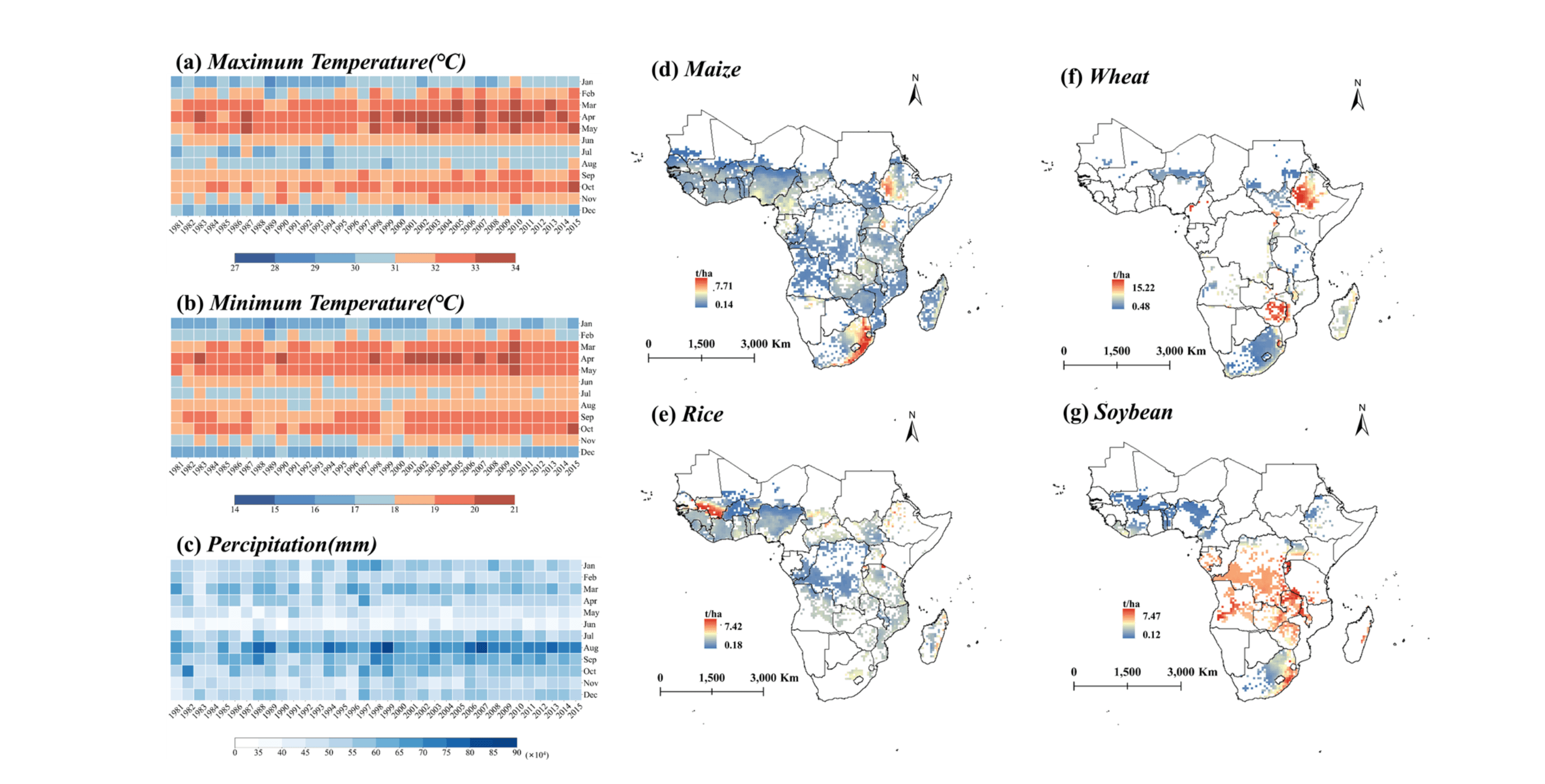
Post-harvest loss in Sub-Saharan Africa is not only a storage and logistics problem. It is a forecasting problem — and climate change is making that problem harder. When crop yields shift spatially and seasonally, infrastructure built to handle them in 2025 may not be in the right place by 2040. Understanding where yields are going, and at what rate, is a prerequisite to building storage systems that remain useful.
A 2025 analysis published in Scientific Reports1 provides some of the most granular data available on this question. Using a random forest model trained on climate variables, land-use patterns, and irrigation ratios from 1981–2015, and projecting forward under three Shared Socioeconomic Pathways — SSP2-4.5, SSP3-7.0, and SSP5-8.5 — across five global climate models,2 the study maps yield trajectories for maize, rice, wheat, and soybean across Sub-Saharan Africa through the 2080s. The findings are not uniform. They vary by crop, by region, and by scenario — and that non-uniformity is precisely what makes them operationally relevant for food system design.
1. Model Performance
The random forest framework achieves R² values of 0.80 for maize, 0.76 for rice, 0.90 for wheat, and 0.90 for soybean on the 80/20 random holdout. Under stricter temporal validation — a five-fold GroupKFold scheme that blocks entire calendar years, and a leave-one-year-out (LYO) protocol — R² values fall to the 0.56–0.82 range, confirming that the model extrapolates to unseen years rather than memorising historical variance.
Wheat and soybean achieve higher overall fit. Maize and rice show slightly lower time-blocked R² values, likely because they dominate Sub-Saharan cultivation patterns, producing larger training samples with more pronounced nonlinear yield-temperature interactions — the kind that machine learning approaches capture but also over-fit to when training data is large and varied.
The historical dataset covers 1981–2015 at 0.5° spatial resolution. Projection periods — 2030s, 2050s, 2080s — represent near-, mid-, and long-term planning horizons relevant to infrastructure investment decisions being made now.
2. Maize: The Primary Risk for West African Food Security
Maize is a C4 crop. Unlike C3 crops, it captures little benefit from rising atmospheric CO₂.3 What it is sensitive to is temperature: grain development above 30°C degrades starch accumulation and increases the probability of crop failure in severely stressed growing seasons.
The projections are consistent across scenarios. Under SSP2-4.5, the maize yield trend shows gradual decline. Under SSP5-8.5, the predicted maize yield in the 2080s falls sharply — the total projected production reaches 22.5 million tonnes against a historical mean of 23.7 million tonnes, a drop of more than 5.2%. The worst outcomes concentrate in eastern South Africa and Zambia, with continuous yield decreases across eastern Africa from Ethiopia to South Africa.
West Africa presents a more complex picture. Nigeria and Angola maintain increasing yield trends even under high warming, while other areas show decline. Ghana, the core of AIDA's current operations, sits in a transitional zone. The spatial heterogeneity matters: continental aggregates obscure local divergence, and investment decisions made at the facility level need to operate at the resolution at which divergence actually occurs.
3. Rice and Wheat: CO₂ Fertilization and Regional Volume Gains
Rice and wheat are C3 crops. Under rising CO₂ concentrations, they benefit from increased photosynthetic efficiency. The data confirms this at scale.
Under SSP5-8.5, rice yield increases by 44.12% relative to the historical baseline, reaching 27.2 million tonnes in the 2080s against a historical mean of 18.8 million tonnes — the most significant percentage increase among all crops and scenarios in the study. Under SSP2-4.5, projected rice yield rises from 21.9 million tonnes to 23.3 million tonnes across the 2030–2080 window. Wheat shows comparable dynamics: consistently upward across all SSP scenarios, surpassing 34 million tonnes under SSP5-8.5 by the 2080s.
The geographic concentration of these gains matters for infrastructure. Rice production is primarily concentrated in West Africa — Nigeria, Benin, Burkina Faso. Increasing rice yields in this corridor under high-warming scenarios means more rice to store and move before it reaches market. Infrastructure sized for current throughput will face capacity pressure before mid-century. If the 44% rice volume projection under SSP5-8.5 is directionally correct, the post-harvest loss surface in West Africa's rice supply chain will grow faster than current expansion plans anticipate.
4. Spatial Heterogeneity and What It Means for Storage Placement
Single-dimensional time series cannot fully describe what climate change does to crop production.4 Yields shift in location, not just magnitude.
Maize yield reductions concentrate in eastern Africa under all high-warming scenarios. Under SSP5-8.5 in the 2080s, nearly all of eastern Africa from Ethiopia to South Africa faces declining maize yields. West Africa shows a different pattern: Nigeria and Angola maintain or increase yields; Mali shows declining rice production driven by reduced precipitation, delayed rainy season onset, and increased drought stress that shortens growing windows.
These are the kinds of localised agroclimate patterns that continental aggregates cannot surface — and they are exactly the patterns that determine where post-harvest infrastructure investment is strategically justified over a 15-year horizon versus where it faces declining supply fundamentals.
5. Implications for Terra Harvest and Terra Climate
Three operational implications follow directly from these findings.
First, storage placement decisions made now will operate across yield regime shifts. A cooperative warehouse built for maize aggregation in a zone facing a 5–10% yield decline by 2050 needs throughput flexibility, not static volume assumptions. Terra Climate's infrastructure advisory function will incorporate SSP scenario projections as an input to long-range storage siting analysis.
Second, West Africa's divergent rice trajectory — significant volume increases under high warming — means that post-harvest loss risk in the rice supply chain will grow faster than current models anticipate. Terra Harvest's crop coverage is currently optimised for maize, cassava, and groundnut. The rice supply chain in West Africa is the next expansion priority.
Third, model uncertainty is operationally relevant, not just a technical caveat. The per-pixel standard deviation across five GCMs and 20 RF seeds is highest in core production zones. Terra Harvest forecasts need to be calibrated against not just historical spoilage patterns but against the expanding variance in growing conditions that these projections represent. A spoilage risk score generated under stable historical climate assumptions has different decision value than the same score generated under an input distribution that is actively shifting.
6. Data Strategy and Model Retraining
The random forest model in this analysis was trained on 1981–2015 data. Its projections assume that historical feature relationships hold forward. AIDA's predictive systems face the same constraint at the facility level: models trained on sensor telemetry from 2024–2026 may not generalise cleanly to 2035 conditions if temperature and humidity regimes at storage facilities shift systematically.
This is not a reason to discount the projections. It is a reason to build systems that are regularly retrained on current data, that incorporate regional climate signals as features alongside local sensor readings, and that flag when input distributions have drifted outside the training envelope. Terra Harvest v2.0 will include explicit distribution shift monitoring as part of the alert architecture — so that the system can distinguish between a spoilage event and a calibration gap.
The 2030 target remains: a 40% reduction in measured post-harvest loss across AIDA partner networks. Climate change does not make that target easier. It makes the precision of the underlying forecasting system more important, because the conditions under which loss occurs will continue to shift.
The underlying crop yield and climate data from this analysis powers AIDA's interactive YieldCast Dashboard — explore yield trends, climate correlations, and loss hotspots across Sub-Saharan Africa.
Citation
Liu, J., Wu, J., Jiang, D., Chen, S., Hao, M., Ding, F., Wu, G., & Liang, H. (2025). Research on the impact of climate change on food security in Africa. Scientific Reports, 15, 3251. https://doi.org/10.1038/s41598-025-14560-5